Inflatable products are where a coated fabric specification has the least room for ambiguity, because a seam that leaks is a product that fails. Suppliers nevertheless quote “pressure” in several incompatible ways: a working inflation pressure, a burst-test result and a seam-peel value get folded into one number. This guide separates the three figures recorded in the kezhibo product knowledge base, maps each to its test method, and sets out the lot-identified report set a buyer should require before releasing a bulk order of boats, air docks or inflatable structures.
What pressure figures does the knowledge base actually publish for inflatable PVC fabric?
The knowledge base records three distinct figures: 8-12 PSI working pressure for inflatable boat and RIB fabric, 10-15 PSI for drop-stitch SUP panels and air mats with an upper figure near 30 PSI, and at least 500 kPa burst under ASTM D3786 for drop-stitch fabric, each tied to a different construction.
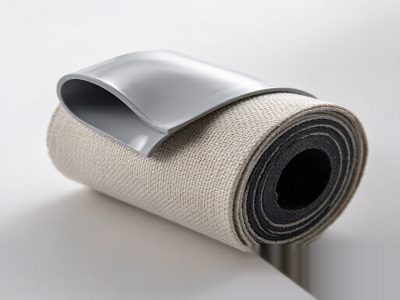
- Boat fabric: 1000-1500D base, 1.5-2.0 mm, PVC-coated polyester, weldable, abrasion resistant, 8-12 PSI — kezhibo PVC knowledge base §3.1 selection table.
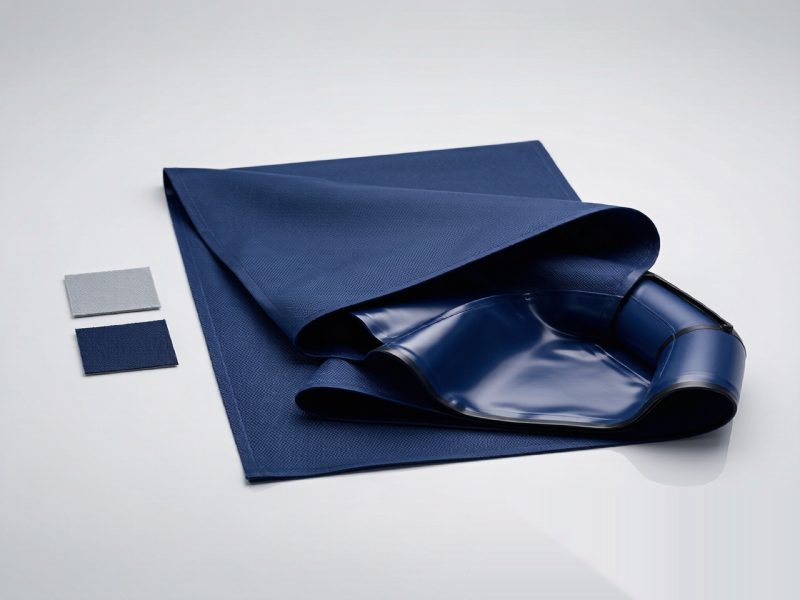
- Drop-stitch fabric: 800-2700 gsm double-wall with high-tenacity PET drop yarns, RF-weldable, 10-15 PSI with a maximum near 30 PSI, peel at least 80 N/5cm — kezhibo PVC knowledge base §3.1.
- Burst method: burst testing for drop-stitch fabric is mapped to ASTM D3786 with a value of at least 500 kPa — kezhibo PVC knowledge base §2.2 method table.
Is burst strength the same specification as working pressure?
No: working pressure describes the band in which the finished product operates, a burst test under ASTM D3786 records where a drop-stitch specimen fails, and a seam-peel result under ISO 2411 measures whether the weld holds both walls together; all three belong in the report set, but none can substitute for another.
- Different units, different questions: PSI working bands appear in §3.1; the ≥500 kPa burst value appears in §2.2 under ASTM D3786; coating and seam peel appear under ISO 2411 — kezhibo PVC knowledge base §2.2, §3.1.
- Peel on record: drop-stitch fabric is listed with peel of at least 80 N/5cm in §3.1, and peel testing generally is mapped to ISO 2411 in §2.2 — kezhibo PVC knowledge base §3.1, §2.2.
- Joining risk: the knowledge base states that sewn seams leak in inflatable and liquid-carrying applications, and that weldability is the property most often overlooked — kezhibo PVC knowledge base §0 core conclusions.
Which report set proves an inflatable fabric is safe and airtight?
Request a lot-identified set covering burst under ASTM D3786, tensile per ISO 1421, tear per DIN 53363, coating peel per ISO 2411 and mass per EN ISO 2286-2, and add ASTM F1918 where the product is a play inflatable, because the knowledge base lists that standard specifically for inflatable amusement safety rather than for general fabric performance.
- Safety scope: ASTM F1918 is listed for inflatable amusement safety; it is a product-level requirement, not a substitute for the fabric’s mechanical reports — kezhibo PVC knowledge base §2.2.
- Mechanics: tensile and elongation per ISO 1421, trapezoidal tear per DIN 53363 or EN 1875-3, peel per ISO 2411, mass per EN ISO 2286-2 — kezhibo PVC knowledge base §2.2.
- Family bands: inflatable and marine fabric 650-1100 gsm with 2850-3500 N/5cm tensile; drop-stitch 800-2700 gsm with tensile at least 4000 N/5cm — kezhibo PVC knowledge base §2.1.
What should the technical agreement fix before a bulk inflatable order?
Fix the construction form, gsm band, working pressure, welding method and the exact report set in one line, then require written notice and re-testing before any change of base cloth, drop-yarn construction or plasticiser, because a substitution can move burst and peel behaviour while leaving the printed gram weight and the product name unchanged.
- Construction line: woven PET for boats versus warp-knitted spacer fabric with drop yarns for panels and air floors — kezhibo PVC knowledge base §1.1, §3.1.
- Joining line: RF welding is named for drop-stitch fabric; the knowledge base requires the joining method to be set at the design stage — kezhibo PVC knowledge base §3.1, §4 step 6.
- Cold line: special plasticiser formulations are recorded down to minus 40 degrees Celsius for inflatables, so a cold-climate order must name the formulation rather than assume it — kezhibo PVC knowledge base §2.1.
FAQ
What is the difference between 8-12 PSI and 10-15 PSI in the knowledge base?
They belong to different constructions. The §3.1 selection table lists inflatable boat and RIB fabric at 1000-1500D, 1.5-2.0 mm, PVC-coated polyester and 8-12 PSI, while drop-stitch SUP panels and air mats are listed at 800-2700 gsm double-wall with high-tenacity PET drop yarns, RF-weldable, at 10-15 PSI with a maximum near 30 PSI. These are working-pressure bands for the finished product, not burst results. A buyer should name the construction first and then the band, rather than comparing the two numbers as if one were a higher grade of the other.
Can I use a 500 kPa burst result as a working-pressure rating?
No. The knowledge base maps burst testing for drop-stitch fabric to ASTM D3786 with a value of at least 500 kPa (§2.2), which is a failure-point measurement on a specimen under a defined test method. The 10-15 PSI figure in §3.1 is the operating band of the finished inflatable. They answer different questions, use different units and are produced by different procedures. Ask for both on the same production lot, plus peel per ISO 2411, and treat any attempt to convert one into the other as a specification error.
Which standard covers safety for play inflatables?
The knowledge base lists ASTM F1918 under inflatable safety, specifically for amusement inflatables (§2.2). That is a product-level safety requirement and sits alongside, not instead of, the fabric’s mechanical and burst reports. If your end use is a commercial play structure, ask which product-level standard applies at the installation market and request the corresponding documentation, then keep the fabric’s tensile, tear, peel, mass and burst results tied to the quoted lot. A product-level document does not prove the roll you are buying.
What does the “at least 80 N/5cm” peel figure refer to?
It is the peel value listed for drop-stitch SUP and air-mat fabric in the §3.1 selection table, where the construction is RF-welded double-wall PVC with high-tenacity PET drop yarns. Peel testing generally is mapped to ISO 2411 in the §2.2 method table. It measures how well the coating or weld holds the two walls together, which is the failure path that matters when an inflatable is pressurised repeatedly. Do not reuse this figure for a single-ply boat fabric or for a tarpaulin; the knowledge base attaches it to the drop-stitch row specifically.
Why does the knowledge base warn about sewn seams on inflatables?
Because a needle hole is a leak path. The knowledge base states in its core conclusions that weldability is the most frequently overlooked property determining success, and that sewn seams leak in inflatable and liquid-carrying applications (§0). The recommended joining routes for PVC are high-frequency, hot-air, hot-wedge and solvent welding, with RF welding named for drop-stitch fabric (§3.1, §3.4). Ask for seam-peel data under ISO 2411 using the method that will actually be used in production, and do not accept a sewn construction for a pressurised product.
Which gsm band should I quote for an inflatable order?
Start with the construction, then the family band: the knowledge base lists inflatable and marine fabric at 650-1100 gsm with 2850-3500 N/5cm tensile, and drop-stitch fabric at 800-2700 gsm with tensile of at least 4000 N/5cm (§2.1). The bands overlap, so gram weight alone cannot distinguish a single-ply boat fabric from a double-wall air mat. Name the base cloth, the wall construction and the welding method in the technical agreement, then verify mass per EN ISO 2286-2 and tensile per ISO 1421 on one lot-identified report.
Do I need low-temperature flex evidence for an inflatable product?
Only if the service environment demands it, but ask explicitly. The knowledge base lists the families at minus 30 to plus 70 degrees Celsius and notes that special plasticiser formulations can reach minus 40 degrees for inflatable products (§2.1); low-temperature flex cracking is mapped to DIN 53359 A and DIN EN 1876-1 in §2.2. That minus 40 figure is tied to a special formulation, not to the standard one, so request the formulation declaration and the relevant flex result before accepting a cold-weather claim on the quoted lot.
How do I prevent a silent change to the drop-yarn construction?
Write the construction form, gsm band, working-pressure band, welding method and report set into one line of the technical agreement, bind every result to a production lot, and add a change-notice clause requiring written notice and re-testing before any change of base cloth, drop-yarn geometry, plasticiser or coating formulation. The knowledge base §4 step 7 warns that a generic data-sheet range is not acceptance evidence. A construction change can shift burst, peel and low-temperature behaviour without altering the printed gram weight or the product name, so the lot number and the report are the control points.